

Going Electric Doesn't Have To Be So Complicated
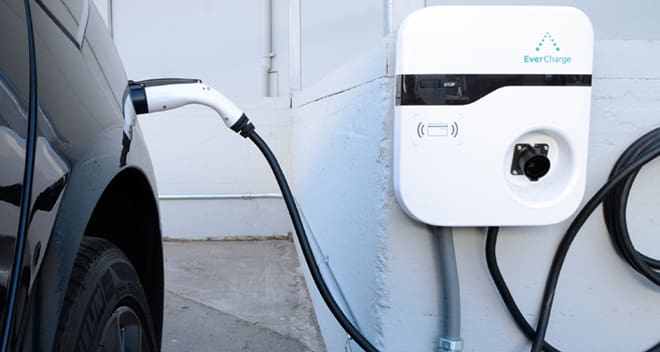
If yous live in Atlanta, Chicago, Los Angeles, Oakland, Portland, Miami, New York, San Diego, San Francisco, San Jose or Seattle y'all're bound to take noticed a surge in electrical vehicles on the road.
With 24 plug-ins now available from multiple manufacturers, plug-ins accounted for nearly iv% of vehicles on the road in 2014, with Tesla alone selling only shy of twenty,000 vehicles. What'southward more than, with the announcement of the exciting all-wheel bulldoze Model Due south and forthcoming Model 10, Tesla will reach new markets and aims to build 100,000 cars in 2015.
Equally the Diffusion of Innovations details, emerging technologies go through phases in adoption. America is at present exiting out of the 'Innovators' phase and into the 'Early Adopters' stage in Electric Vehicles. Until now, only people that could work an electric vehicle into their existing lifestyle fabricated the switch. People who take easy admission to charging, about likely via their own individual garage and power source, have been the primary purchasers.
Tesla has been very open about its plans to build an electrical car around the $twoscore,000 price point, substantially opening upwardly its demographic by an order of magnitude. The California Air Resources Board has also publicly stated that by 2040, every single new machine will be zero emission; significant, either electric or fuel cell. (Probably won't be the latter, see why Mr. Musk believes hydrogen isn't the answer)
If Tesla and other manufacturers want to start selling more EVs, they have to start addressing a massive demographic that has been overlooked; residents of Multi-Tenant Buildings, besides referred to as Multi Habitation Units (MDUs). This designation includes condominiums, town homes, apartments, and mobile homes. In San Diego, 51% of residents fall into this category. In California overall, it is just shy of 39%. About of these residents park in a large covered or uncovered lot, parking garage, or some other communal situation. Well-nigh half of the urban EV market is beingness ignored. Ironically, this high density marketplace is where EVs are catching on, also. So, you take more than potential buyers with less practical means of charging.
Some charging companies out there retrieve they take a solution. They say, 'Let'south put a few public chargers nearby or on the property, that will solve the problem!'
Um' No. Information technology won't, and here is why:
If I have my own parking space at my condo or apartment, I want to park in it everyday. I don't want to come home, cantankerous my fingers that nobody else is using one of the public chargers, and and then walk to my place with groceries and get yelled at to move my car for the next resident later.
What happens after 5 EVs are on the holding? What almost x, and 20, and 100? Publicly available charging may kind-of work for a handful of EVs, but subsequently that, at that place just isn't plenty charging to go around. But put, it's not scalable.
Electric current public charging systems are absurdly expensive. I recently spoke to one business possessor who paid $xvi,000 to install one at his office. It tin accuse two cars simultaneously. I counted 6 Teslas in the parking lot. Hmmm' seems like there is not enough to become around.
Alright, and then public charging isn't the answer. Then what are the other options? Well'
Y'all could run an extension string from your automobile...
Across your parking lot, over your yard, and into your home. Of course, this would only be a 110V line, meaning y'all volition get a whopping i-iii miles of charging per hr. Yous can probably last a few days before someone complains that this is either a hazard or any eyesore:
 This is an actual extension cord running from an EV into a resident's house.
You could luck out, and find an outlet right side by side to your car.
But the problem is that the outlet isn't continued to your meter, then you don't pay for the power and are essentially stealing from the customs. How long can that work?

Plugging into an available outlet.
You could phone call up an electrician, and instruct him to run a line from your own power meter to your parking spot.
Of form, this would non work for renters. For homeowners, this tin piece of work in theory, but nosotros oft see situations where a resident's meter is 500 anxiety and 6 walls away from their spot. This means it is incredibly expensive for an installation. Furthermore, the parking area will expect similar a bowl of spaghetti (conduit running every which way) if more residents decided to go this route.

Complicated layouts make for a mess of conduit.
You could run a line to the house panel.
(The console for the common area lights, doors, etc. The HOA or building owner usually pays for this.) However, in that location is often only capacity for 2-3 vehicles before making massive infrastructure upgrades. Recently, we met with a 400 unit California building that had allowed 3 Tesla owners to run lines to the house panel. Everything was fine until the 4th Tesla showed up, and received the unfortunate news that it would be $30,000 to upgrade the infrastructure to permit for the additional car. Had they gone with EverCharge, they would have been able to support 18-30 EVs earlier they needed to upgrade.
The reality is that EV charging takes a massive amount of electricity.
 (Photo courtesy of Joel Pointon and SDG&East)
Simultaneously, the amount of electricity inbound a building or belongings is finite, so how do you ensure that all residents have the ability that they need without overtaxing the system and tripping breakers all solar day long?
Enter EverCharge. EverCharge makes the most sense from the beginning vehicle to the 500th, about notably considering of scalability.
The charging stations are installed directly in residents' dedicated parking spaces for their sectional use and so they don't need to worry nigh where they volition plug in at night. The proprietary organisation communicates wirelessly to expand the capacity of a property past a gene of up to ten times. The engineering science intelligently allocates the available power to requesting vehicles maximizing the infrastructure potential, enabling buildings to support many more vehicles before costly upgrades are required.
California Ceremonious Lawmaking Section 1352?'?1353.9 protects homeowners by forbidding HOAs from denying a resident's request to install charging. The HOA doesn't accept to pay for the system, simply they tin't disallow it. This same law has some requirements, though. Chiefly, a $1,000,000 insurance policy has to be in order. With EverCharge that policy is included.
EverCharge keeps rails of the power that a resident uses, bills them accordingly and reimburses the HOA or edifice possessor automatically, and then that they aren't paying for a resident's power. Allow's call it a win-win-win-win because EV owners go power, car manufacturers sell more EVs, greenhouse gases are reduced, and HOAs/building owners don't take to worry about the logistics.
Charge Sequencing in action:

A bright futurity lies ahead for EVs. Only, it won't come without many issues to address. EverCharge decreases the barriers to go electric for a significant portion of the population.
Source: https://evercharge.com/blog/why-americans-cant-charge-at-home/
Posted by: jenkinsbrebrugh.blogspot.com
0 Response to "Going Electric Doesn't Have To Be So Complicated"
Post a Comment